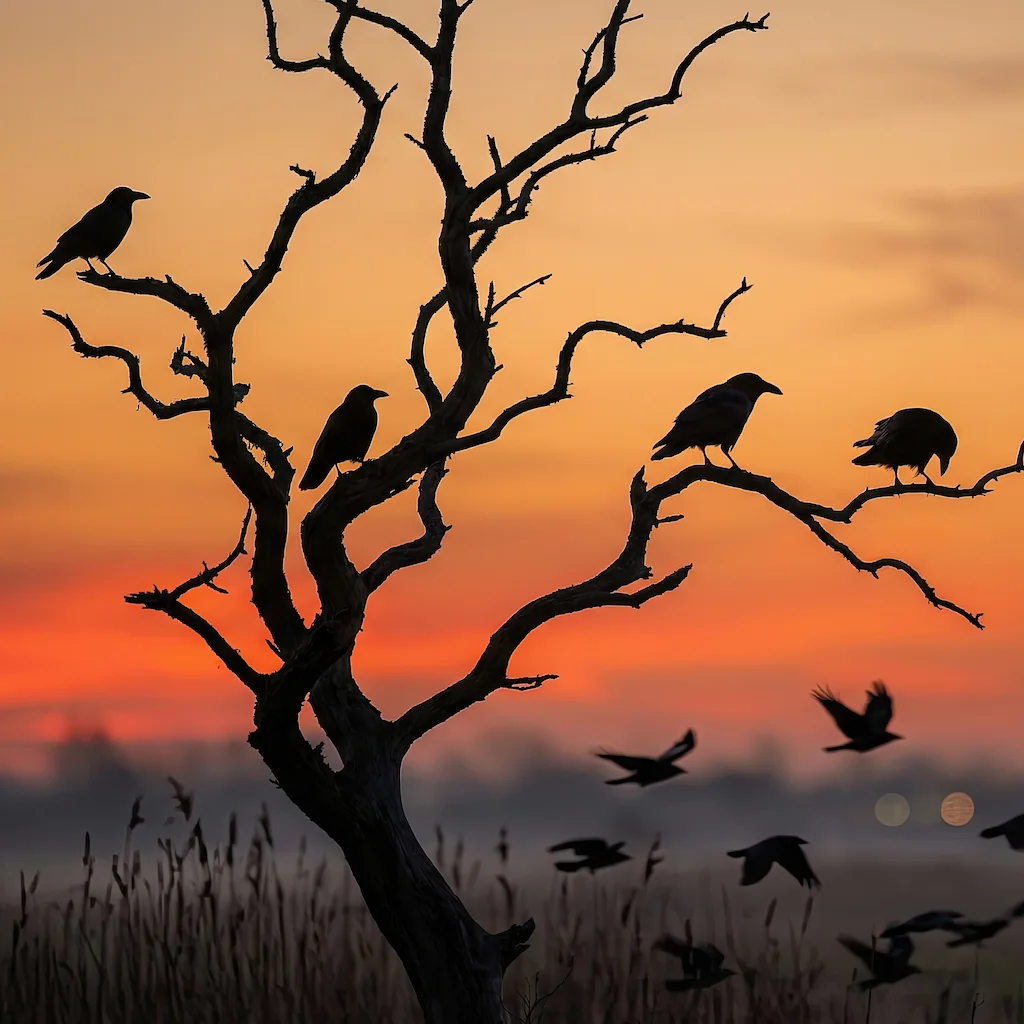
Have you ever noticed a crow watching you from a tree or a rooftop? It may seem like an ordinary black bird, but behind those dark eyes is a surprisingly active mind. Crows can solve problems, remember useful information and learn from one another. Their intelligence helps them live in forests, fields and busy cities. However, not every crow species has exactly the same skills, and scientists are still discovering what these birds can do.
One of their most impressive abilities is recognising human faces. Researchers at the University of Washington tested this by wearing special masks while they caught and marked several American crows. The birds connected one of the masked faces with this unpleasant experience. Later, when people wore the same mask and walked through the area, the crows followed them and made loud warning calls. They continued to react to the face years later. Even more interestingly, other crows also began to treat the masked person as a threat, although some of them had not seen the original event. This suggests that crows can share information about danger.
Some crows are also excellent toolmakers. New Caledonian crows, which live on islands in the Pacific Ocean, use sticks to reach insects inside small holes. They can even shape plant material into hooks, making it easier to pull food out. In scientific tests, these crows have solved tasks with several steps. For example, a crow may first need to use a short tool to reach a longer one. It can then use the longer tool to get the food. In another experiment, New Caledonian crows joined separate pieces to create one tool that was long enough. This does not mean that crows think exactly like humans, but it shows that they can understand difficult problems.
Their behaviour around dead crows is another interesting part of their lives. When a crow finds a dead member of its species, it may call loudly and attract a large group. People sometimes describe these meetings as “crow funerals.” However, scientists are careful about this name because they cannot know whether the birds understand death or feel sadness in the same way that humans do. Research suggests that these gatherings have a practical purpose. The crows examine the area and learn about possible danger. If they see a person near the dead bird, they may remember that person and avoid them later.
Crows also have active social lives. Many live in family groups, and young American crows sometimes stay with their parents for several years. They may help protect the family’s area and feed younger birds. Crows communicate through different calls and watch how other group members behave. If one crow finds food or notices a dangerous animal, its actions can give useful information to the others. Their ability to learn socially means that knowledge can spread through a group without every bird having the same experience.
Living close to people gives crows many new problems to solve. They learn when streets are quiet, where food is usually left and which people are safe. However, we should be careful not to believe every amazing story about them. A personal story can be interesting, but a controlled experiment gives scientists stronger evidence.
The next time a crow looks down at you from a rooftop, remember that it may recognise more than you expect. Its world is filled with faces, family relationships, useful tools and warnings about danger. To us, it may be only another bird in the city. To other crows, it may be a teacher, a helper or an important source of information.